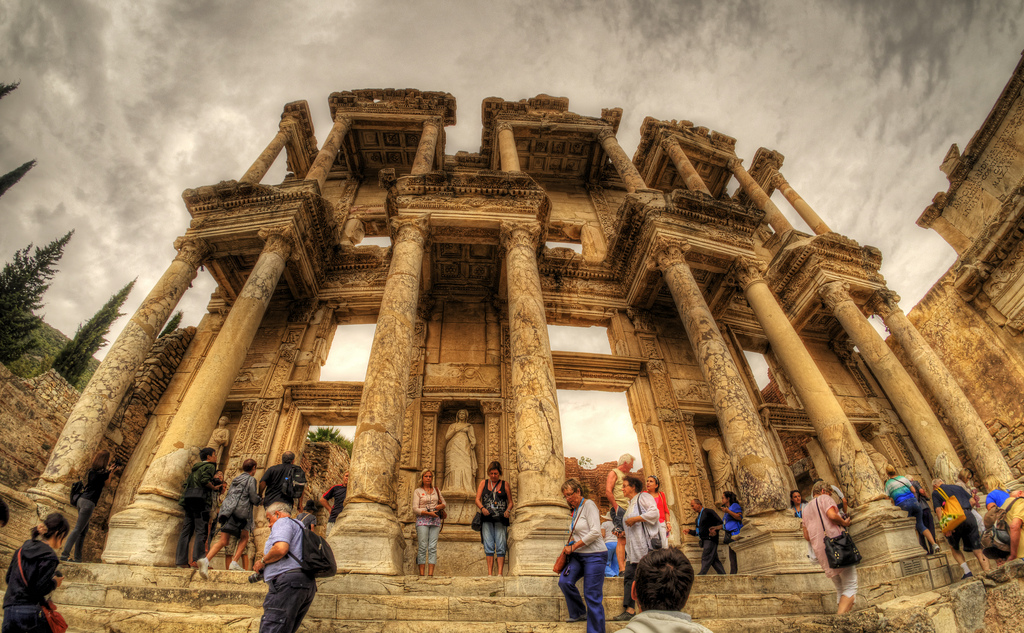
Most people picture Ephesus as one photograph: the two-storey facade of the Library of Celsus, glowing in late light. It really does look like that. What the photo leaves out is the crowd standing in front of it at 11 in the morning, the marble that throws the heat back at you, and the fact that a lot of visitors walk the whole site in the wrong direction.
None of that is a reason to skip it. Ephesus is one of the best-preserved Roman cities anywhere around the Mediterranean, and it has been a UNESCO World Heritage Site since 2015. It just pays to go in with a plan.
Start at the top, finish at the library
The site has two entrances. The upper gate sits near the State Agora, and the lower gate is down by the Great Theatre. The street between them runs downhill, so if you start at the upper gate you spend the next two hours walking gently down instead of climbing up a slope of polished stone.
This sounds minor until July. Starting at the top also means the library and the theatre come at the end, which is the right order. You build up to them instead of seeing the highlight first and then trudging uphill past things that suddenly feel smaller. A good driver will drop you at one gate and wait at the other, which is one of the quiet advantages of private Turkey tours over a coach that has to park in one place.
Beat the cruise ships, not just the heat
Kuşadası, the nearest cruise port, is only around 20 kilometres away. On busy days the coaches tend to roll in mid-morning, and the main street fills up fast. There are two ways around it.
The first is simply to be at the gate when it opens. The light is softer, the stone is still cool, and you can stand in front of the library without a selfie stick in your ear. The second is to go late in the afternoon, once the ship groups have been called back to port. Late visits suit photographers, because the library facade faces east and the low sun lights the courtyard in a way the midday glare never does.
Whichever you choose, bring water and a hat. There is very little shade on the main street, and summer temperatures in this part of the Aegean regularly climb well into the 90s Fahrenheit.
Pay for the Terrace Houses
This is the part most rushed visitors skip, and it is the part people talk about afterward. The Terrace Houses are a block of homes where wealthy Ephesians lived, now sheltered under a modern roof. Inside you walk on raised glass walkways above mosaic floors and past walls still covered in painted plaster.
Entry costs extra on top of the main ticket, which is why group tours often leave it out. Give it at least 45 minutes. The ruins outside show you how the city was laid out. The houses show you how people actually lived in it, down to the room where somebody kept their kitchen.
The Great Theatre, and why to sit down
The theatre is carved into the slope of Mount Pion and held roughly 24,000 people. Climb a few rows up, sit for ten minutes, and look straight down the Harbour Street. The sea has retreated miles from the old port over the centuries, which is a big part of why the city declined, and from up here you can picture the masts that once stood at the end of that road.
It is also where, according to the Book of Acts, a riot broke out against the apostle Paul. For travelers following the early Christian sites, that one detail changes how the whole place feels.
Leave time for Selçuk
The modern town of Selçuk sits about ten minutes away, and it is where Ephesus continues. The Ephesus Museum holds the statues of Artemis that were found on the site. The Basilica of St. John stands on the hill above town, and nearby a single rebuilt column marks where the Temple of Artemis once stood, one of the Seven Wonders of the ancient world.
Most coach itineraries see the ruins and leave. If you can, stay the night. Selçuk has small family-run hotels, an easy evening atmosphere and a weekly market, and the hill village of Şirince is a short drive up the valley for dinner.
How Ephesus fits into a wider trip
Ephesus works best as part of a route instead of a frantic day trip from Istanbul. Izmir airport is about an hour's drive away, and Pamukkale's white travertine terraces are roughly three hours further inland. That makes a natural loop: Istanbul, a short flight to Izmir, two nights around Selçuk, then on to Pamukkale and Cappadocia.
If you are building this kind of loop, it helps to work with Turkey private guided tours that let the guide set the order of the day around the crowds instead of a fixed timetable. At Ephesus especially, an hour earlier or later decides whether you remember the place or the queue.
A few practical notes
- Wear shoes with grip. The marble paving is worn smooth and can be slippery.
- Plan on at least three hours for the main site and the Terrace Houses together.
- Spring and autumn are the most comfortable months. April, May, late September and October bring milder days and thinner crowds.
- Read up on the city before you go, or bring a licensed guide. Without context, a lot of Ephesus is beautiful but silent.
Ephesus has survived earthquakes, invasions and the sea walking away from its harbour. It can survive a little planning on your part. Arrive early or late, walk it downhill, and give the houses the time they deserve.