
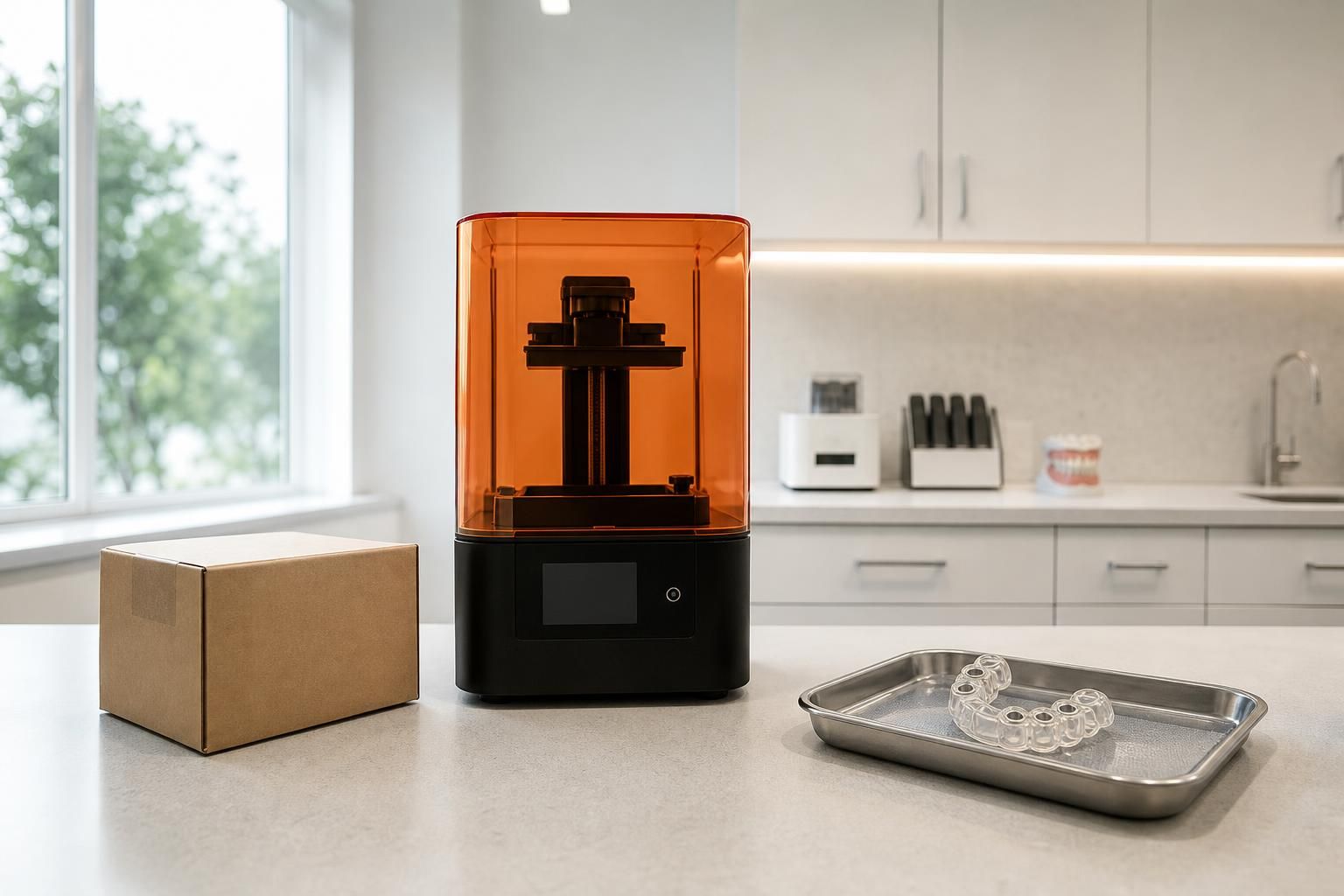
Desktop resin printers have become far more capable and affordable, and many dental practices now ask the same question: should we start printing our own surgical guides, or keep working with an outside lab? Both paths can produce good results. The right choice depends less on the printer itself and more on case volume, team skills, workflow and how much responsibility the practice wants to take on.
This article offers a practical framework for comparing in house guide production with an outsourced surgical guide lab in 2026.
What In House Production Really Involves
Printing a guide is only one step. A full in house workflow usually includes several stages, each with its own learning curve:
- Merging CBCT and surface scan data accurately
- Planning implant positions with restorative goals in mind
- Designing the guide, including support, sleeves and inspection windows
- Printing with a validated material and correct settings
- Cleaning, post curing and finishing according to the material instructions
- Inserting sleeves and checking fit before use
Each stage needs time, training and quality control. The printer is often the simplest part of the system.
Advantages of Printing In House
Control over timing
When everything sits under one roof, the team can move a case forward on its own schedule. This can be helpful for practices with steady guided case volume and a team member dedicated to digital work.
Direct feedback loop
Designers and surgeons can discuss a case face to face, which can make adjustments quicker for straightforward cases.
Learning and capability
Some clinicians enjoy owning the full digital process and see it as part of their professional development.
Challenges of Printing In House
Equipment and materials
Beyond the printer, practices typically need a wash unit, a post curing unit, validated resins, software licences and space with suitable ventilation. Materials and consumables add an ongoing cost.
Staff time and training
Planning and design are skilled tasks. If the person responsible is also a clinician or assistant with a full schedule, guide work can compete with patient care.
Quality control responsibility
When the practice designs and prints the guide, it also owns the quality checks. Settings, material handling and post processing must be followed carefully every time.
Advantages of Working With an Outsourced Lab
An experienced lab spreads its planning and production expertise across many cases. For practices that place implants occasionally, or that see a mix of simple and complex cases, this can be the more efficient route. Labs that provide custom surgical guides for dentists typically handle data merging, planning drafts, design and fabrication, while the clinician keeps responsibility for reviewing and approving the plan.
Outsourcing can also give access to a second set of experienced eyes on complex cases, such as full arch treatment or sites close to vital structures.
Challenges of Outsourcing
Working with an outside partner means planning around their schedule and shipping time. Communication also matters. A lab that is slow to respond or unclear about revisions can make the process feel distant. When comparing partners, ask how revisions are handled, who reviews plans, and how questions are answered.
Comparing Cost Without Guesswork
Cost comparisons are often oversimplified. A fair comparison looks beyond the price of resin or the lab invoice and considers:
- Equipment purchase, maintenance and replacement over time
- Software licences and updates
- Staff hours spent on planning, design and post processing
- Remakes caused by design or processing errors
- The value of clinical time freed up by outsourcing
On the outsourced side, many labs use case based pricing, since effort varies with the number of implants and the complexity of the case. When reviewing dental surgical guide cost, ask for a quote based on your actual case mix rather than comparing single headline figures.
A Simple Decision Framework
These questions can help a practice decide which route fits best:
- Volume: how many guided cases do we expect each month, and is that number stable?
- People: do we have a team member with time and interest to own planning and design?
- Complexity: are most of our cases simple single sites, or do we see many complex and full arch cases?
- Risk: are we comfortable owning quality control for every guide we produce?
- Flexibility: would a hybrid approach work, with simple cases in house and complex cases outsourced?
The Hybrid Option
Many practices find that the answer is not either or. A hybrid model lets the team print straightforward guides in house while sending complex or unusual cases to a lab. This approach builds internal skill gradually while keeping expert support available when it matters most.
Final Thoughts
Choosing between in house printing and an outsourced surgical guide lab is a business and clinical decision at the same time. The best choice is the one that delivers reliable guides consistently, fits the team's skills and schedule, and keeps the clinician firmly in control of the plan. By looking at volume, people, complexity and true costs, practices can make a decision that supports predictable guided surgery for years to come.